
Beyond compliance: Building a culture of safety in industrial workplaces
January 29, 2026 in Machine Safety Blog byEstimated reading time: 11 minutes
Introduction
In many industrial workplaces, safety efforts begin and end with compliance. Guards are installed, procedures are written, and training records are filed away. On paper, everything looks acceptable. On the shop floor, however, risks remain.
Compliance can be challenging because it requires sustained attention, effort, and motivation, especially under real production pressures. In fact, to create a safer work environment, workers’ attitudes may need to be changed, which is not an easy task. Building a safety culture takes a lot of time and consistent effort. But the payoff is worth it because the risk of injury drops, and the team respects and trusts one another.
For manufacturing managers, supervisors, and shop owners, building this type of culture does not require becoming a safety engineer. It requires commitment and characteristics, including developing and implementing a communication strategy, securing resources, and empowering people. It requires awareness, consistency, and a willingness to address risks before an incident forces action.
What safety culture really means
What is a safety culture?
A safety culture is not a poster on the wall, a set of rules, or a once-a-year training session.
A culture of safety goes beyond meeting minimum requirements. It considers human behavior, production pressures, and maintenance realities. A safety culture is the collective mindset of the company at all levels that prioritizes safety over ease or pace. Safety researchers often describe it as the shared values, norms, and behaviors that determine how safety is managed day-to-day.
It’s what people do when they are not being observed by a supervisor, how they react to hazards and unsafe work practices, and how they behave toward management and co-workers.
In practical terms, a strong safety culture means:
When safety becomes part of daily operations instead of a separate task, compliance tends to follow naturally.
An early lesson in workplace culture
Changing workplace culture and people’s attitudes is not an easy task. Sometimes, unsafe practices are instilled through rituals shaped over years of company culture.
This reminds me of the time I worked at a metal fabrication shop many years ago. It was the kind of place where you learned fast by watching the people around you and copying their actions and behaviors. In fact, many experienced workers seemed to see themselves as part of an old-boys’ club. There was an unspoken expectation that you earned acceptance by doing things the same way they always had.
What stood out to me was not the machines or the noise, but the attitude towards safety.
Face shields, hearing protection, gloves, and even basic guarding were often treated as unnecessary. Guards were described as useless or in the way.
Wearing PPE was seen as uncool. PPE was put on only if someone important was visiting. The supervisor would be seen walking through the shop in a panic, advising every worker that the government safety inspector was on their way to conduct an inspection.
New employees learned quickly by example. If a new worker showed up wearing all the recommended PPE, it did not take long before comments started. Nothing aggressive, but enough jokes and side remarks to make the message clear. If you wanted to fit in, you stopped wearing it.
Over time, that attitude became normal. Experienced workers passed it down to new ones, not because they wanted anyone to hurt, but because that was simply how things had always been done. The culture shaped behavior far more than any written rule or safety sign on the wall.
That experience stuck with me. It showed how easily unsafe habits can become accepted, and how powerful peer influence is on the shop floor. When safety is treated as optional or inconvenient, new workers learn that message long before they read a procedure.
As I changed careers and began conducting machine safety audits at different facilities, I started seeing the same pattern again. At one site, I put on a hard hat after noticing overhead cranes in operation. When I looked around, I realized I was the only person wearing one.
At another facility, I watched a worker repeatedly pounding metal with a hammer without any hearing protection.
At yet another shop, I saw a welder working nearly 12 feet in the air, one foot on a ladder and the other on a rotating vessel.
What stood out was not a lack of skill or effort. In every case, people were simply doing what had become normal in their workplace. The risks were not hidden. They had just become accepted. And yet, safety cannot rely solely on equipment. Guards, PPE, and procedures matter, but the environment surrounding them matters just as much.
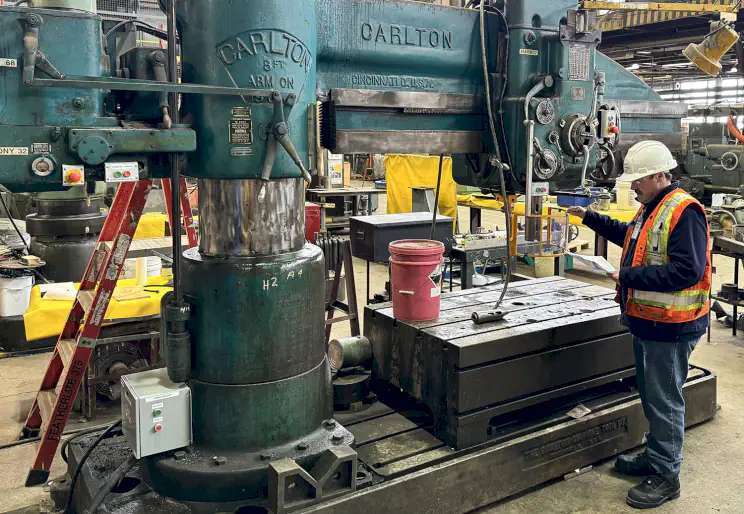
Communication is KEY!
In many workplaces, safety conversations become most visible only after something goes wrong. Outside of those moments, safety becomes quiet, besides the occasional required formal meeting. Over time, that silence sends a message. When safety is rarely talked about, it is often assumed to be less important than production.
Overheard Conversation
Worker 1: “Hey, did you hear Bob got the tip of his finger cut off yesterday?”
Worker 2: “No, I didn’t. What happened?”
Worker 1: “Apparently, he was clearing a jam behind the shear.”
Worker 2: “Seriously? That thing’s always been sketchy. I knew one day something like that would happen.”
Worker 1: “Yeah. They’re saying we’re all supposed to lock it out now before clearing jams.”
Worker 2: “We weren’t doing that before?”
Worker 1: “Not really. Nobody ever said anything. We’ve all been doing it the same way for years.”
Worker 2: “So now it’s a rule because someone got hurt.”
Worker 1: “Pretty much. They had a quick meeting this morning. Told everyone to be more careful.”
Worker 2: “That’s brutal. Bob’s been here forever, too.”
Worker 1: “Yeah. And honestly, it could’ve been any one of us.”
There are a lot of things wrong with this conversation, but I don’t think it’s unrealistic. The hazard was not new, and the task had been performed the same way for years. The difference is that safety communication only began after someone was injured. When guidance, expectations, and procedures are introduced reactively, workers are left learning lessons the hard way. A strong safety culture aims to identify and address these risks before an incident forces the conversation.
Research on workplace safety behavior shows that employees take cues from what leadership communicates consistently. What supervisors speak about regularly becomes what workers view as normal and expected. This is how safety culture forms, not through written rules, but through repetition.
Studies also indicate that workers are more likely to follow safety requirements when they understand the purpose behind them. When expectations are communicated without explanation, they are often seen as inconvenient or unnecessary. When the reasoning is shared, compliance improves, and resistance decreases.
Communication works best when it flows both ways.
Workers need to feel comfortable raising concerns without fear of being dismissed or ridiculed. Operators and maintenance personnel are often the first to notice developing hazards. When those observations are ignored, employees quickly learn that speaking up is not valued, and the culture shifts toward silence.
Safety climate research consistently highlights that respectful, ongoing communication between management and workers plays a major role in shaping day-to-day safety behavior. When unsafe practices are overlooked, they become accepted. When concerns are acknowledged and addressed, safe behavior becomes the norm.
Simple communication habits help reinforce a strong safety culture:
- Asking how work is actually performed, not how it is assumed to be done
- Involving all levels of employees in decision-making
- Explaining why guarding, interlocks, or procedures exist
- Encouraging reporting without blame
- Responding consistently to both safe and unsafe behavior
Safety culture does not grow from one conversation. It develops through many small interactions over time. Short, regular discussions often have more impact than occasional formal meetings.
When communication is clear, consistent, and respectful, safety becomes part of daily operations rather than a separate program. That is when procedures are followed, not because they are written, but because they reflect how the workplace truly operates. In fact, informal group norms often outweigh written procedures.
Common mistakes seen in industrial shops
Guarding was only added after an incident
This is a common and costly pattern in industry. Many facilities revisit machine safety only after someone gets hurt or a near-miss occurs. I can’t count the number of times I’ve gotten a call from someone in a panic because machines are locked out and production has ground to a halt.
By that point, the cost is already higher, both financially and personally. A safety audit is no longer voluntary; often, it is now required by government agencies and insurance companies. Machines that fail safety audits may be locked out, and production stopped.
Proactive assessments often identify the same hazards before an event occurs.
Your Next Step is Just a Call Away.
Ferndale Safety can help you with:
Fill out the form, and one of our safety experts will get in touch with you shortly.
Treating guarding as an obstacle
When guards interfere with workflow, operators find ways around them. This usually indicates that the safeguarding method was not well matched to the task.
Effective machine guarding should allow work to be done safely and efficiently, not force unsafe shortcuts.
Did you know? Adding some high-intensity task lighting increases visibility and in my experience, it lessens the likelihood that a safety shield or guard is bypassed or removed. Let’s not make workers strain to see their work. We don’t think about it that way, but adding task lighting is an inexpensive safety upgrade.
Lack of ownership
If safety is seen as the responsibility of a single person, such as the safety coordinator, issues can easily go unnoticed. Machine safety works best when supervisors, maintenance, and operators all share responsibility.
No review after modifications
Equipment rarely stays exactly as it was installed. Any modification, even a small one, can change the risk profile. Without review, hazards quietly grow.
Why compliance alone is not enough
Regulations (such as OSHA requirements) and consensus standards (such as CSA, UL, and ISO frameworks) exist to reduce risk. They establish minimum expectations for safeguarding, control systems, and work practices.
The challenge is that standards cannot account for every real-world condition.
Consider a common example. A machine is purchased with proper guarding from the manufacturer. Years later, the process changes. A new fixture is added. A door is propped open to speed up loading. An interlock switch is bypassed to keep production moving.
Technically, the machine was compliant when installed. Practically, the risk has increased. And here’s the question: has the machine been reassessed for safety compliance? Is there even a procedure or a way to document changes?
This gap between written compliance and real operation is where many incidents occur.
Building safety into daily operations
Involve the people who do the work
Operators and maintenance staff often understand risks better than anyone else. Involving them early leads to better solutions and stronger buy-in.
Keep procedures realistic
If a procedure cannot be followed during real production, it will eventually be ignored. Procedures should reflect actual workflows, not ideal ones.
Train with purpose
Training should explain why controls exist, not just what the rule says. When workers understand the reason behind a guard or interlock, compliance improves.
Document and revisit
Risk assessments and safeguarding decisions should be documented and reviewed periodically, especially after process changes or equipment upgrades.
Measuring progress without paperwork overload
Building a safety culture does not mean creating endless forms. Useful indicators include:
- Fewer bypassed guards
- Increased hazard reporting
- Safer maintenance practices
- Better communication between departments
These signs often matter more than the number of documents on file.
Closing thoughts
Machine safety works best when it is planned, reviewed, and maintained as part of everyday operations. A strong safety culture helps reduce risk, supports compliance efforts, and creates a more reliable workplace.
For industrial facilities of any size, thoughtful safety planning is not about checking boxes. It is about understanding hazards, choosing appropriate controls, and building habits that protect people while keeping production moving.
Taking the time to look beyond compliance is one of the most effective steps a workplace can take toward long-term safety performance.
Further Reading
OSHA – Recommended Practices for Safety and Health Programs: A comprehensive guide from the U.S. Occupational Safety and Health Administration describing proactive safety program elements and how they prevent injuries and illnesses before they occur.
WorkSafeBC — Enhancing Health & Safety Culture: Defines active health and safety management, leadership commitment, and worker engagement as foundational to improving safety culture.
References
- Haas EJ, Yorio PL. (2021) Behavioral safety compliance in an interdependent mining environment: supervisor communication, procedural justice, and the mediating role of coworker communication. Int J Occup Saf Ergon. 2022 Sep;28(3):1439-1451. https://pmc.ncbi.nlm.nih.gov/articles/PMC11049610/
- Hu, X., Jimmieson, N.L. and White, K.M. (2022), Understanding compliance with safe work practices: The role of ‘can-do’ and ‘reason-to’ factors. J Occup Organ Psychol, 95: 405-430. https://doi.org/10.1111/joop.12382
- Hassan, Zuraida, et al. (2019), The Connection between Safety Compliance Behavior, Safety Communication and Safety Standard and Procedure: An Investigation among Workers in Malaysian SME’s. Academy of Entrepreneurship Journal, Volume 25, Special Issue 2, 2019. https://www.abacademies.org/articles/The-connection-between-safety-compliance-behavior-safety-communication-and%20safety-standard-1528-2686-25-S2-283.pdf
- Abdulla, Thair, and Abulqadir Hattab. “Influence of Safety Culture on Employee Compliance and Accident Reduction in Hazardous Industries.” International Journal of Scientific Research and Engineering Development, vol. 8, no. 2, Apr. 2025, pp. 263–272, www.ijsred.com/volume8/issue2/IJSRED-V8I2P22.pdf. Accessed 29 Jan. 2026.
- Strzałkowski, P., Bęś, P., Sitarska, M., Woźniak, J., Pactwa, K., Konopacka, Ż., & Niemiec, K. (2025). Management Commitment to Compliance with Occupational Safety and Health Laws and Regulations in Polish Rock Mining Companies. Sustainability, 17(20), 9168. https://doi.org/10.3390/su17209168

